
Maintaining stable environmental conditions (such as temperature and humidity) is a fundamental requirement for the proper functioning of fine art storage facilities intended to hold artworks, rare objects and products that require rigorous climate control, such as wines. For this reason, such spaces demand significant investment in climate control systems with high energy consumption.
Given the current scenario, in which the global climate crisis imposes the need to rethink the use of natural resources, it becomes essential to prioritise energy efficiency, that is, to guarantee that ideal conditions are maintained with the lowest possible energy consumption.
As well as contributing to environmental sustainability, the adoption of energy-efficient solutions brings a direct reduction in operating costs, above all in electricity. However, achieving this balance requires appropriate technical planning and physical infrastructure. Although it is still the most common solution, the use of in-house fine art storage by collectors and museums presents challenges that are difficult to get around.
After all, it is not enough simply to install an air conditioner in the room where the collection will be kept. Unlike domestic climate control, aimed mostly at temperature control, the preservation of cultural collections of excellence requires a focus on controlling the relative humidity of the air, the key variable in preventing the deterioration of collections as a result of the proliferation of fungi and pests.
“Humidity control requires robust systems, similar to those used in data centers. Naturally, this reality only makes sense when large spaces are being climate-controlled, which makes the investment unviable for environments smaller than a thousand square metres”, explains Diogo Losito Mantovani, CEO of Clé Reserva Contemporânea.
In this context, it makes more sense to use shared facilities, capable of housing advanced climate control systems and the thermal insulation that guarantees energy efficiency. “This is the reason why collective fine art storage facilities are growing at a dizzying rate worldwide. When you consider that conservation is a permanent need, there is no other possible path than that of collective uses that allow sustainability in conservation”, adds Mantovani.
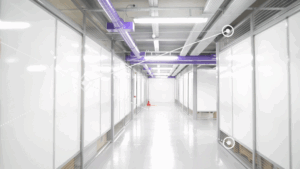
Clé Reserva Contemporânea has a complete infrastructure with climate control and humidity control systems across its 5,500 square metres of storage area, as well as fire prevention and property security systems. The scale of the operation allows maximum use of energy and technical resources, which is reflected in lower operating costs for clients, compared with setting up their own systems.
“This format of a collective storage facility with private, segregated spaces for each client allows us to have the best of both worlds: a state-of-the-art climate control system, efficient and sustainable, without losing privacy and confidentiality, an essential condition for serving clients”, he concludes.
All these distinguishing features will be incorporated into the new warehouse currently being adapted to expand the available fine art storage area. In the new conservation centre, clients will be able to choose private spaces from 25 m² (and multiples of that area), or more flexible solutions, with shared storage of small collections or individual pieces, always with a guarantee of ideal climatic conditions and energy efficiency.
For more information, get in touch with our specialist team.